Caching Approaches for API Based Enrichments
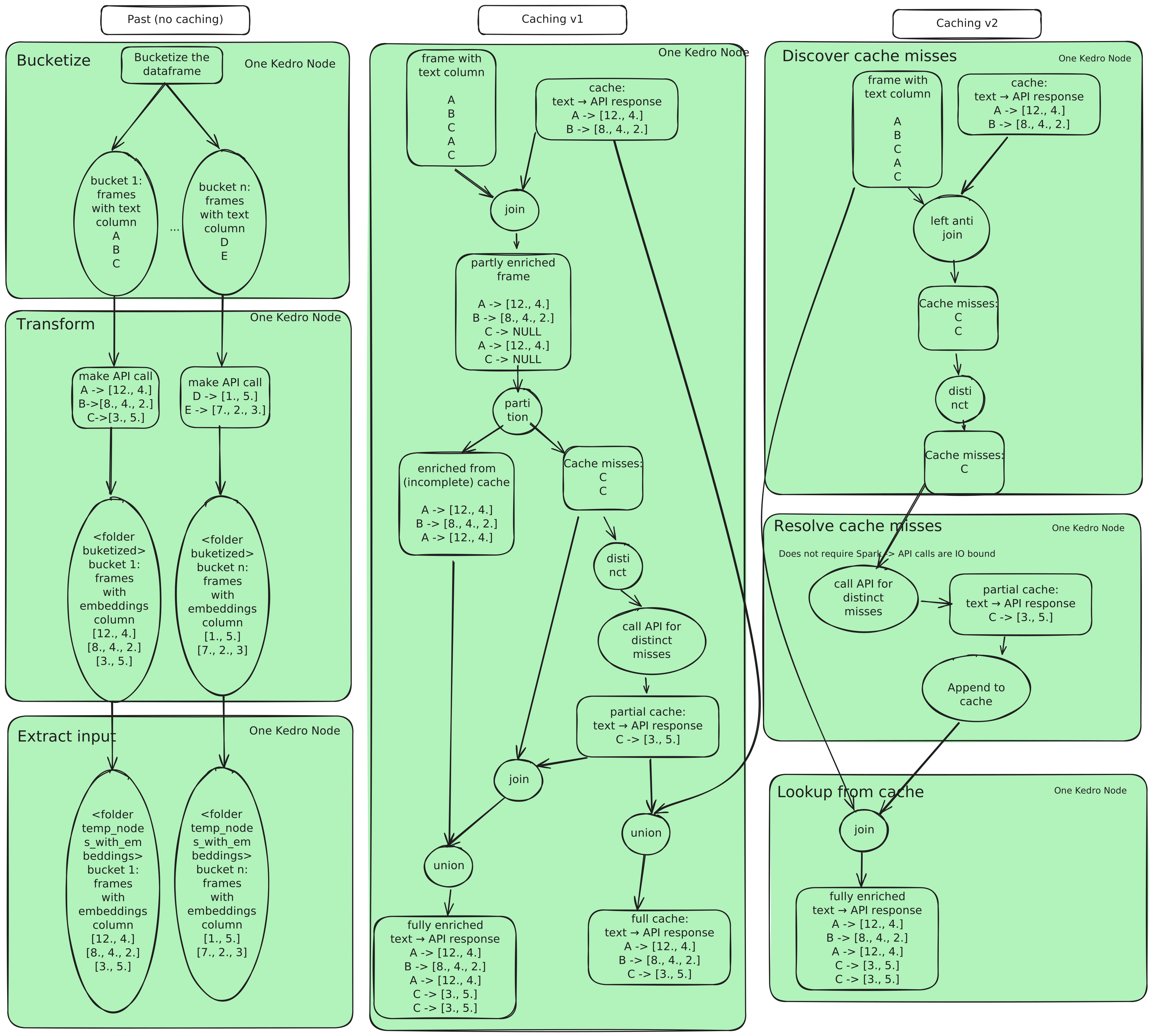
This document describes the current approach to optimizing data enrichment using external APIs.
Context
The matrix's data processing pipelines use external APIs to enrich certain datasets. As an example, the node embeddings and node normalization steps send data to REST APIs, and use the APIs' responses to enrich the data.
Problem statement
REST APIs usually have fair-use restrictions, such as the number of requests per minute (RPM) that can be processed. Exceeding these limits typically results in throttling: the service ignoring, sometimes even blocking, your requests for a while. These restrictions, together with network latency cause steps in which a large number of API calls are to be made to be slow steps. Even with zero network latency, there is a lower bound to the duration of such steps. We'll provide an example later.
The issue becomes particularly problematic when the API calls are repeated, which is the case in the current design of the Matrix's pipelines: each end-to-end run repeats calls to these services for the largely unchanging datasets with millions of rows.
Solution
Since most API calls are idempotent, simply caching the results would result in a substantial reduction in computation time, thus saving costs.
Current implementation
The caching strategy consists of 3 steps:
-
Discover Cache Misses
-
Perform a left anti join to identify missing entries in the cache.
-
Extract distinct missing values. The reason to have distinctiveness is that the data to be enriched might have duplicate keys. It would be a poor use of time if the API has to return the same reply for identical keys.
-
Resolve Cache Misses
-
API calls are made only for distinct misses.
- The results are stored in persistent storage, rather than an in-memory database, to save costs as the cache does not need to be queried constantly: the pipelines are not streaming pipelines, but batch pipelines.
-
The results of these lookups will be appended to the original cache, to get a cache that would not have resulted in cache misses had it been used from the start.
-
Lookup from Cache
-
A final join operation retrieves embeddings from the updated cache.
Advantages
Faster pipeline execution
Caching network calls is a way to reduce computation time. Thus, it contributes towards a goal of being able to run the end-to-end pipeline at a higher frequency.
Optimized resource usage
The first and third steps are more computationally demanding than the second, and as such are good cases for Apache Spark in the cases where we're processing large datasets. To add some numbers here: embeddings needed to be found for 12M strings of 100 characters each in Feb 2025.
The second step however, is a poor case for Apache Spark's distributed computing: the process is inherently IO bound, so throwing more CPUs at the problem won't solve it. Instead, one can typically optimize this by going for less processes, even down to the single process level, where concurrency techniques like threading and asynchronous IO can truly shine.
The current implementation takes that into account by separating those 3 steps onto Kubernetes pods in Argo Workflows with different resource requirements: whereas steps 1 and 3 can benefit from many cores, step 2 gets far less. Each step also has different memory and possibly disk requirements, depending on the batch size, the API responses and the volume of cache misses. With 3 separate ArgoResourceConfigs, one has this control.
Easier control over concurrent API calls
By having only a single process reaching out to the APIs, it becomes easier to limit the number of concurrent API calls to not get throttled. Had this been done with Spark, using user-defined-functions, then the number of Spark executors (and the allocated threads) have to be taken into account as well. With dynamic allocation (which is at the time of writing not enabled), this becomes even trickier. It would require interprocess communication (IPC). Note that retry mechanisms, such as the one enabled by the tenacity library, alleviate the situation somewhat. However, intelligent back-off mechanisms would still require more engineering than a single process using semaphores and other synchronization primitives, in combination with a retry mechanism.
Disadvantages
Increased network traffic from GCS
While caching comes with an inherent increase of local network traffic, it is offset by a decrease in external network traffic. However, this paragraph does not focus on this part (as that is a tradeoff, typically a favorable one). No, this is about the choice for using 3 separate pods instead of one single one (a "fuse-node", in Matrix terminology).
As the three pods do not share a volume, nor Kedro's, nor Spark's initial caching mechanisms can be used. These mechanisms would keep datasets obtained over the network, e.g. those from GCS, to be stored locally between kedro nodes/Spark jobs. At this point, we assume the cost of running with caches, obtained from GCS is less than that of keeping a multicore machine up while idling, waiting for network IO. Should this not be the case, an easy step to take would be to fuse the 3 nodes, as has been done in the past. At that point though, one may consider just creating a single kedro node and benefitting from Spark's memory+disk caching. Such considerations are only worth it if the added network cost outweighs the benefits of reducing resource requirements during the second step. After an initial setup of the cache, the second step would reduce essentially to a no-op, so that's a big win.
Risk of duplicate elements
This is a problem inherent to writing in parallel with concurrent workers. While a single Spark job has mechanisms in place to ensure no two workers write the same files, multiple concurrent jobs do not have this guarantee. As such, this problem is present for all data-generating jobs in the Matrix project that feature multiple workers (i.e. all of the Kedro SparkDatasets).
There are multiple ways to tackle this:
- There are some locking mechanisms available for object stores, e.g. Google Cloud's "Request Preconditions". The downside is that this is not built-in to Spark, so we'd be writing custom code.
- use of a table format that supports ACID transactions, like Apache Iceberg/Databricks Delta/Apache Hudi.
- resolving duplicates with a call to create unique values
The latter is the simplest (single line of code), and has been chosen. The second option was rejected for now, as it would introduce a technology that the core developers do not have enough experience with yet. However, its advantages, like dataset versioning and upsert possibilities have been highlighted, as they may prove useful in other pieces of Every Cure's pipelines.
The downside to using the simplest approach is that over time duplicates may end up in the cache, thus creating a situation one would not expect from a cache (it should have unique keys). When the situation is detected, a warning is thrown, visible in the logs. Warnings can easily be changed into Exceptions, so that the processing would stop immediately if that is desired. However, the chance of concurrently creating caches is considered small, just like concurrent generation of the KG is considered a small risk.
The downside to generating a warning is that Spark will need to iterate over the data at least twice, which for big data is to be done sparingly. In this case, it's considered to be a small cost, since it only needs to go over a single dataset, which isn't PiB large either. Additionally, care has been taken to only go over it one extra time, by using a single aggregator.
Past work
Previous iterations of the current pipeline are summarized in the graph above. Only one other iteration has has caching implemented.
The mapPartitions approach
The cache miss resolver step was implemented using Spark's
mapPartitions mechanisms. It requires a serializable callable. Objects
keeping state, like locks and database connections, cannot be used for such
purposes. The workaround is to instantiate those objects inside the callable,
effectively creating them in the executor processes.
For most use cases, this won't matter: nearly all common use cases of classes
in data engineering can be written as functions, where some degree of
dependency injection is lost. However, since the function being passed to
mapPartitions is a parameter, one could simply create multiple functions,
each injecting its own dependency.
mapPartitions provides for a quick and elegant solution, since
it immediately reuses Kedro's Dataset definitions that have already been made
in the catalog for the other 2 steps in our 3-step caching mechanism. That
means we don't need to add extra catalog entries to parse a Parquet dataset
using a different engine, like Pandas, thus keeping a lighter catalog. Note
that the 2nd node (the cache miss resolver) will still use more workers if
given them. In the committed design, we have explicitly given it only a single
CPU to make best use of resources.
Conclusion
Using a three-stage caching mechanism allows optimizing compute resources, and reducing the time of consecutive runs substantially.