Secure private datasets
Status
Under review
Context
At the time of writing, Every Cure (EC) and its subcontractors ("subs") are using a single Google Project under which all of the infrastructure, like the container storage (GCS), the object store, and the Kubernetes service, is hosted. Several other services, like Google Cloud Secret Manager are also hosted here.
This Google Project is called "mtrx-hub-dev", with an id mtrx-hub-dev-3of. As the name suggests, it is a development environment, which is commonly associated with a place where developers add new features before being deployed to a production environment, possibly through staged deployments.
The majority of this set of services is managed using Terraform and Terragrunt, two popular Infrastructure as Code (IaC) tools. These tools work by looking at the state of the infra branch of the matrix project and deploy the changes from the repo's top-level infra folder.
Once these services have been deployed, ArgoCD comes into play, where the app of apps pattern is used to declaratively bootstrap other apps.
As part of this environment, EC is hosting data that is public in nature: anyone can find the information online, the info is free of charge and unrestricted by licenses.
Problems
- Datasets that aren't public in nature, which we'll label as sensitive or private from here on, will need to be added to Every Cure's set of assets, while protecting it with some form of access control so that it can only be read by Every Cure staff.
- The state of the infrastructure is coupled to the state of the processing code, in the sense that the IaC codebase defines different node pools, while the workloads define their resource requirements that should fit on these node pools. As an example, some kubernetes pods are sized for processing certain datasets. As the processing code evolves, sometimes changes in the pod configuration are entered which might break the option of processing data.
User context
Approach
We'll mirror the current "dev" environment using a second Google project.
Rationale
Data (and logs) are made available to users under the following (non-exhaustive list of) services:
- GCS (uses Google SSO)
- BigQuery (uses Google SSO)
- MlFlow (uses Google SSO)
- Argo Workflows (uses Google SSO)
- ArgoCD (uses Google SSO)
- Neo4j (username, password)
For the latter, access to unauthorized staff should be prohibited, so that they
cannot read logs, nor trigger workflows. That is, the URL
https://argo.platform.dev.everycure.org/workflows/ should be hosted
separately so that people without access cannot even see the logs.
Considering these services, it's easier to restrict access using the Google Cloud authentication flow using SSO, rather than on per-app level.
- Do we need a separate K8s cluster for this?
PRO:
-
making changes to the K8s cluster, like adding nodes, redimensioning them, becomes less impacting, as long as people understand that the dev environment might show breaking infra. As a result, you can deploy with confidence to prod.
 if subcontractors, who were meant not to work on prod (because
that's where we have the private data), start complaining that services are
sometimes not operational, then there should be even a 2nd non-prod
environment. Dev should be for making changes to infra and pipelines. This is
deemed acceptable.
if subcontractors, who were meant not to work on prod (because
that's where we have the private data), start complaining that services are
sometimes not operational, then there should be even a 2nd non-prod
environment. Dev should be for making changes to infra and pipelines. This is
deemed acceptable.
Permission management: a group of users would be granted permission to the prod cluster. If there were only one cluster, that group of users would need to be granted permissions to different namespaces. Additionally, certain cluster roles, like those for Argo Events require cross-namespace permissions. With multiple functionally equivalent namespaces (like argo-workflows-prod and argo-workflows-dev) this division is made harder. all kinds of objects (namespaces, services like Argo, cluster roles) would not need to have suffixes (or similar)
CON:
-
2nd infra to manage.
- Counterargument: it’s with modules in Terraform. Overall cognitive load is considered low.
-
Should we use multiple Google Projects?
PRO
- Quotas are usually linked to Google Project IDs (there are a few linked to the organization-level), meaning there’s less chance of hitting quota limits.
CON:
- it might slow down development.
- COUNTERARGUMENT: switching k8s context is a single command, as is switching a Google Project. Can be in the Makefile.
For the same reason as above in what services the data must be made available, and the separate Kubernetes cluster considerations, it is easier to continue with a second Google Project. Additionally, this facilitates billing, as one would otherwise need to resort to tags and labels.
For Neo4J (and possibly other services where there is no OAuth flow using your GC credentials), credentials (username, password) are typically stored in a secrets vault, like Google Cloud Secret Manager, under the same keys as they would be in other environments. This has the advantage that storing such secrets from Terraform is easy, as well as retrieving these programmatically, since users do not need to know different secret names. This will be done by setting up a new git-crypt scope, that would encrypt the k8s_secrets_prd.yaml. It would be decrypted in the CICD pipeline and its contents pushed to the external secrets service of the prod account. See image below.
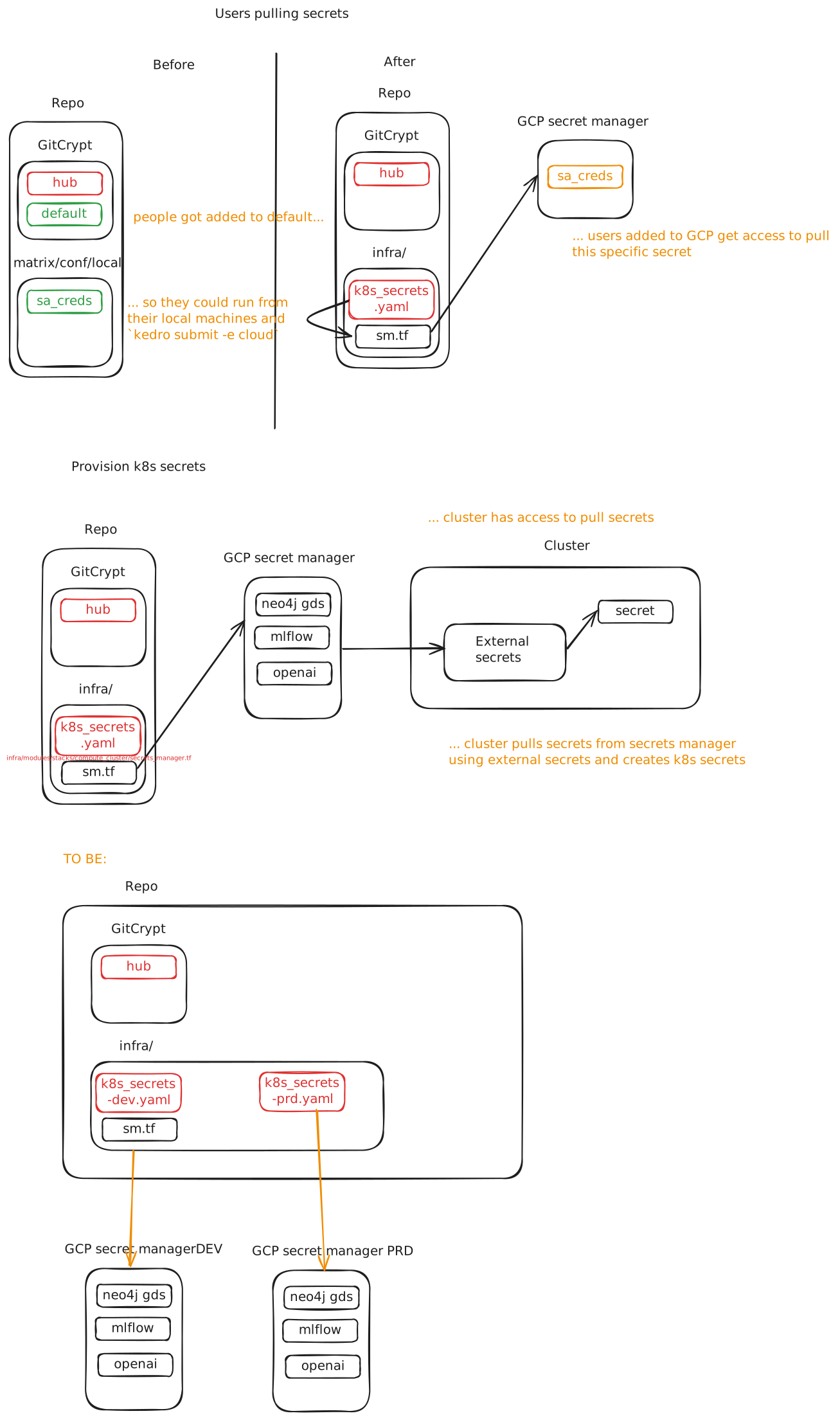
-
Should authorization be granted through Google project ids? It seems so, as it makes it easier for granting access to MLFlow and Neo4J.
-
Shall we have infra-dev and infra-prod branches? Yes, because we’re using ArgoCD and we want to avoid having a commit in the infra folder affecting both environments.
Proposal: move infra, both the Terraform/Terragrunt parts, as well as ArgoCD, to its own repo, matrix-infra.
This would create less friction, as we'd need 2 infra branches for ArgoCD now, and the current "merge main to infra, then infra to main" sequence is already distracting from the main goal of having something simply deployed.
Out of scope: whether there should be dev and prod branches for non-infra related development, such as triggering a release in the production environment.
Rationale: has nothing to do with the private data being stored and the solutions discussed so far.
- If this is about dataset protection, what is the impact if it gets used by unauthorized people?
Depends on the contractual arrangements. Possibilities: loss of funding, lawsuit, reputation damage.
- What costs can be incurred?
An extra cluster costs about 4500$/month, based on the current consumption in the current cluster during the weekend.
- Is the MVP clear? What are the Minimum Acceptance Criteria? The following is a list of the acceptance criteria as laid out initially. The list is not exhaustive.
iii) Completion Criteria A mirrored environment available under *.platform.everycure.org which has executed a pipeline run E2E successfully and is set to replace the existing dev environment for data release runs. argo/mlflow.platform.dev.everycure.org argo/mlflow.platform.everycure.org
- How will this be used?
The idea is that a selection of Every Cure staff gets access to the “production” environment (i.e. the Google Cloud project). There, they can inspect the protected datasets, together with the doubled public datasets.
- Does the public data need to be duplicated, in order to facilitate using environment-agnostic code? Or de we add environment checks and modify pipeline?
Duplicating the data makes for easier management, as no exceptions need to be made. A downside is that it comes with an extra storage cost for the ingested data and that the public datasets in both envs may grow out of sync, though that can be solved with cross-bucket repliccation
As decided in PR 1189, production workloads will read public data from dev, and private data from prod.
- Should we create a different yml in the env folder, e.g. cloud-prod?
It has been decided in PR 1189 not to do so: the private datasets will be
added to the existing catalog.yml files. The way it should be working then is
that environment variables or CLI flags will be used to enable/disable the
inclusion and processing of the private datasets, which is highly similar to
the current process of selectively disabling/enabling datasets by commenting
them out from the DYNAMIC_PIPELINES_MAPPING in the settings.py file.
- Who is the handful of people that needs access to this private data?
engineering@everycure.org (sic Pascal)
Decision
We create a Google Project for prod (it already exists) and redeploy the currently existing infrastructure there. We add a catalog entry for the private datasets in an already existing conf/cloud folder.